What do we mean by planet placement? Here at the Green Stories Project, our goal is to see more best-selling stories that, in subtle ways, inspire us to walk more lightly on the planet. This doesn’t mean books have to be ‘about’ climate, but rather, where possible and appropriate, normalise behaviours through character actions and values, often in unintrusive ways! Like product placement but ‘planet placement’.
The article, Sustainability for Writers and Publishers, by Denise Baden, professor of sustainability and writer provides more detail.
You can find some good examples here in the Top 20 Fiction Books to Inspire Climate Action list: https://thebookslist.com/20-fiction-books-to-inspire-climate-action/. The first few books, especially, show how mainstream genre fiction: a rom-com, action adventure, Roman epic, and thriller all inspire climate action in various ways.
Keep on reading to explore some different ways authors and publishers can consider this further.
On this page, you’ll find information about…
- Fictional characters as influencers
- Offer for publishers
- Costs
- One-to-one consultations for authors
- Relevant research
Fictional characters as influencers
Most writers and organisations care about climate change and nature, and want to do their bit, for example, with use of recycled materials and sustainable production. However, the greatest impact writers have is on the stories they tell. Research shows that attitudes and values are affected on a subconscious level by those we come across in stories.
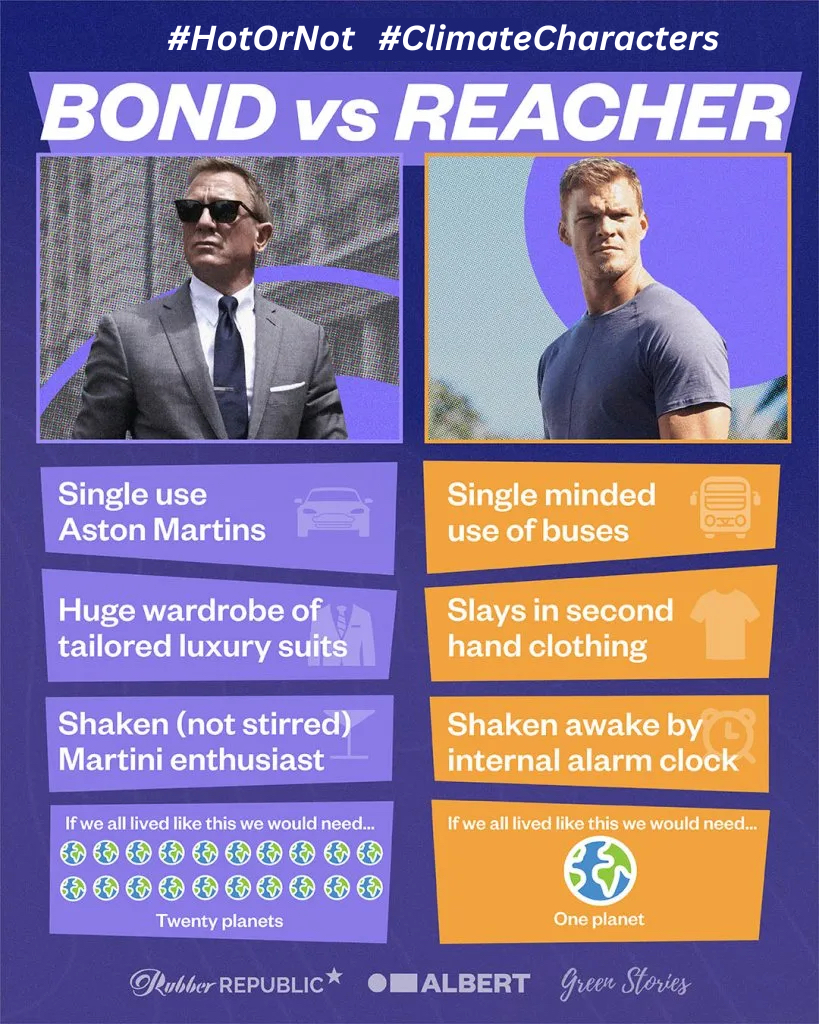
- Is our hero a jet-setter or does he travel by bus (like Jack Reacher).
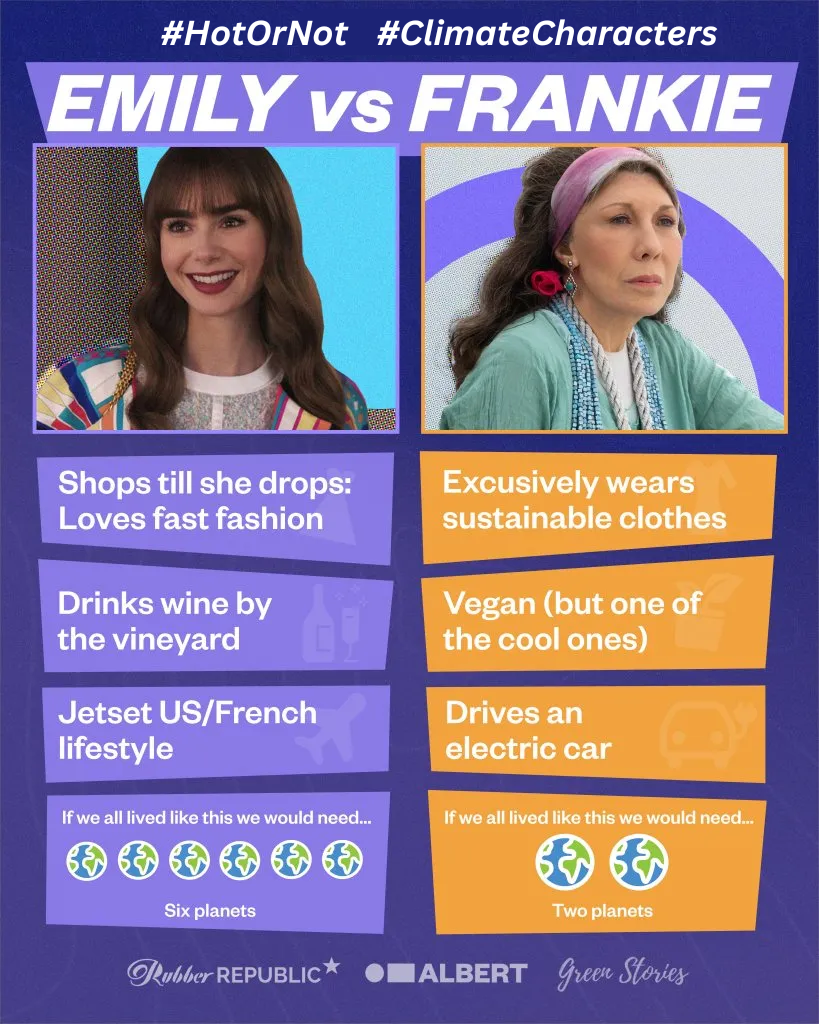
- Does she have a walk-in wardrobe like Carrie in Sex in the City/And Just Like That, or does she wear vintage/charity shop clothing like Frankie in Grace and Frankie?
- Fast fashion accounts for huge amounts of pollution, water scarcity and 10% of greenhouse gas emissions, so it made a difference when the TV show Skins dressed their cast in charity shop clothes, boosting a cultural change in shopping habits.
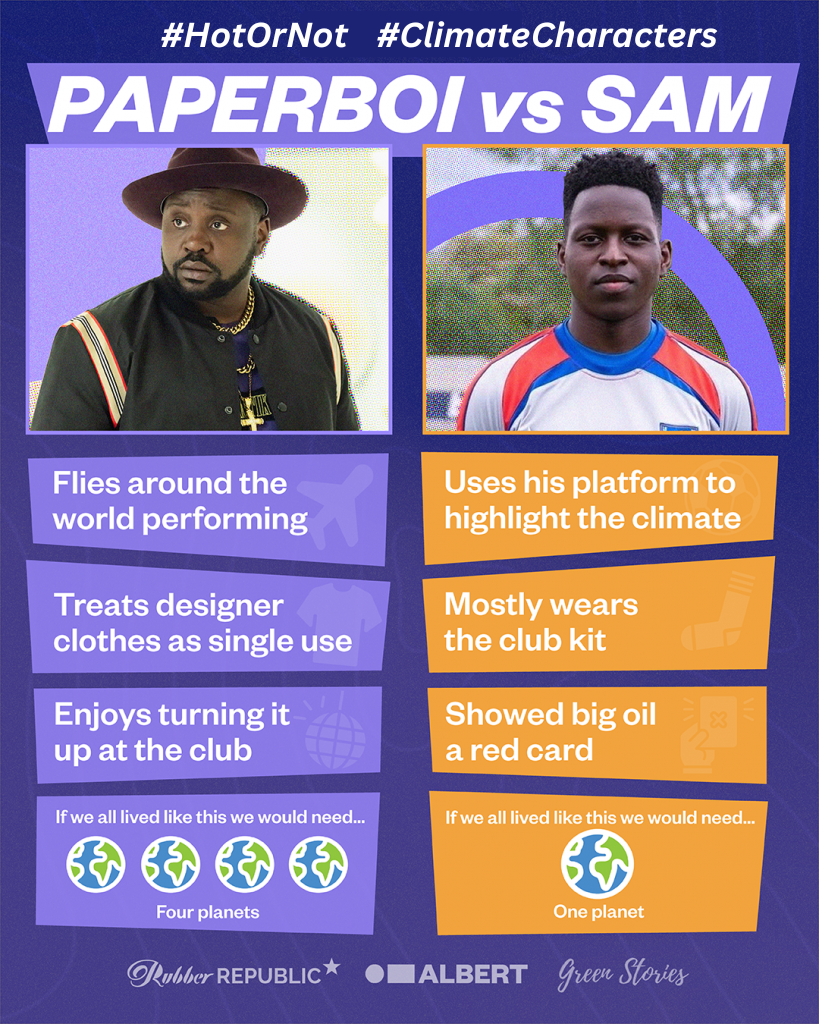
Our #ClimateCharacters project with Bafta showed how tiny adjustments that aren’t consciously noticeable can add up to a big impact without every story having to be about climate or every character needing to be a ‘greeny’.
Offer for publishers
Most of us care about climate and nature, but few writers realise the outsize impact they have. Regardless of your conscious intention, the choices your characters make help to shape social norms. For example, your characters, whether you realise it or not, will have an attitude towards their consumption. It may be ‘more is better’, or it may be mindful of waste. They may notice nature or treat the earth as something to be exploited without thought.
We provide workshops and consultations to help authors, especially those of genre fiction, to sprinkle nature-friendly morsels throughout their characters and plot, without compromising the entertainment value of the novel. Story and character come first. For example:
- Crime fiction involves dead bodies, and often a burial – could this be a natural burial?
- Could the romantic trope of shopping for clothes for the big date be replaced with a fashion swap?
- Could the couple ask for a doggy bag after passion interferes with their ability to finish their meal?
Such tweaks help to normalise nature-positivepractices without readers even noticing.
Denise Baden is an expert in ‘planet placement’ and has delivered numerous keynotes, workshops and consultations based on her research into positive role models, fictional characters as influencers and sustainable practices. She is a professor of sustainability, with a PhD in psychology, is a writer herself, and is on the Forbes List of Climate Leaders Changing the TV and Film industry. She also runs the Creative Climate Communications newsletter on LinkedIn. Her research on how climate-themed stories land with readers inspired the Green Stories mission, and she helps to run Habitat Press. You can find out more here.
Costs for publishers*
* Green Stories is a not-for-profit organisation, and fees from workshops will go towards a Green Stories prize/award. Payment is requested after the workshops/presentations/consultations once the publisher/author is happy with it.
Limited time launch offer: 50% off workshops that take place before 31st October 2026.
Choose from the following options: (prices also available in $ for non-UK publishers).
- £100 for a 30-minute presentation, which would be mostly lecture-based with examples, allowing 5-10 minutes at the end for questions. (£200 after 1st Nov 2026)
- £115 for 45 minutes with more time for discussion at the end. (£230 after 1st Nov 2026)
- £130 for one hour, which includes writing activities. (£260 after 1st Nov 2026)
- £150 for 2-hour workshop which includes writing activities and feedback and brainstorming around ideas. (£300 after 1st Nov 2026) [Recommended for best results]
- Full morning/afternoon/day sessions are also available for in-person events. Please ask if interested.
Block offer for publishers and discounts
A 2-hour online workshop plus up to 10 individual author consultations of 30 minutes each for £500 – a saving of £250. (£1000 after 1st Nov 2026)
Offer for authors
Limited time launch offer: 50% off consultations that take place before 31st October 2026
Denise can provide one-on-one consultations for individual authors at a cost of £75 each (£150 after 1st Nov 2026). This includes access to a recorded presentation, reading any pre-sent materials (up to 3,000 words which may include outline of plot/characters and/or extracts of text), and a conversation of 30 minutes discussing how to ‘planet place’ sustainability into the story without compromising entertainment value. This can be very light. For example, a couple of tweaks designed not to be consciously noticed by readers, or more extensive, such as a subplot or a character dedicated to environmental issues.
Payment is requested after the consultation once the author is happy with it.
If you are an indie/low-earning author, please get in touch for details of discounts.
Relevant research by D.A. Baden
Baden, D. and Pearson, N. (in press) ‘Culture and climate: Does it matter how fictional characters on screen behave?‘ Oxford Intersections: Climate Adaptation.
Baden, D., and J. Brown: 2024, ‘Climate Fiction to Inspire Green Actions: Tales from Two Authors ‘, In Wang, H. and E. Coren (Eds.), Story telling to Accelerate Climate Solutions (Springer, Cham, Switzerland).
McIlroy, R. C., Baden, D. A., Brown, J., Gauthier, S. M., Swierczynski, J., & Wilks, S. A. (2024). Clean vs green: the impact of reading short stories on sustainable and healthy cleaning behaviours. Discover Sustainability, 5(1), 356.
Baden, D. (2023). Thrutopia: a fictional roadmap to a sustainable society. Association for the Study of Literature and Environment, UK and Ireland: Transitions 2023
D Baden, 2022. The Missing Ingredient to Fight the Climate Crisis: Positive Role Models. The Conversation,
Baden, D.: 2020 ‘Which Work Best: Cautionary Tales or Positive Role Models?’, In Molthan-hill, P., H. Luna, T. Wall, H. Puntha and D. Baden (Eds.), Storytelling for Sustainability in Higher Education: An Educator’s Handbook (Routledge, Abingdon).
Baden, D.: 2019 ‘Solution focused stories are more effective than catastrophic stories in motivating pro-environmental intentions ‘, Ecopsychology 11 (4), 254-263.
Baden, D.: 2018, ‘Environmental storytelling can help spread big ideas for saving the planet‘, The Conversation,
Baden, D., C. Burns, A. Jahan and L. Bartlett: 2018, ‘Engaging people in sustainability via stories’. British Academy of Management Bristol, UK.
Baden, D.: 2017, ‘The differential effects of exposure to positive and negative role models and news stories on behaviour’. Making people feel bad: What is the role of negative appeals in marketing? Queen Mary University of London.
Baden, D.: 2014, ‘Integrating ethics into business school teaching – the importance of positive role models’, In Murray, A., D. Baden, P. Cashian, H. Kathryn and K. Wersun (Eds.), Integrating ethics into business school teaching – the importance of positive role models (Greenleaf, Sheffield, UK).
Baden, D.: 2014, ‘Look on the bright side: a comparison of positive and negative role models in business ethics education’, Academy of Management Learning & Education 13 (2), 154-170.
Baden, D. and M. Cory: 2012, ‘The effect of positive vs. negative role models of business on student attitudes and intentions’. BAM Cardiff.
Other research on how fictional characters affect behaviour
Appel, M., & Richter, T. (2007). Persuasive effects of fictional narratives increase over time. Media Psychology, 10(1), 113-134.
Bilandzic, H., & Busselle, R. (2013). Narrative persuasion. The Sage handbook of persuasion: Developments in theory and practice, 200-219.
Cha, Y., & Kwon, Y. (2018). Why Korean young women consumers buy luxury goods? The influence of cultural orientation and media use. Asian Journal of Business Environment, 8(2), 23-32.
Eisend, M., & Möller, J. (2007). The influence of TV viewing on consumers’ body images and related consumption behavior. Marketing Letters, 18(1), 101-116.
Gerbner, G. (1969). Toward” cultural indicators”: The analysis of mass mediated public message systems. AV communication review, 137-148.
Gerbner, G., Gross, L., Morgan, M., & Signorielli, N. (1980). The “mainstreaming” of America: Violence profile number 11. Journal of Communication, 30(3), 10-29.
Green, M. C., & Brock, T. C. (2000). The role of transportation in the persuasiveness of public narratives. Journal of Personality and Social Psychology, 79(5), 701.
Hoeken, H., Kolthoff, M., & Sanders, J. (2016). Story perspective and character similarity as drivers of identification and narrative persuasion. Human Communication Research, 42(2), 292-311.
Khancheh Sepehr, S., & Naseri, E. (2010). The Role of Media Representation of Consumption Models in Formation of Audience Consumption Behaviors and Attitudes. Communication Research, 17(61), 119-147.
Kumar, A., & Kumra, R. (2021). Television viewing and conspicuous consumption of households: evidence from India. Journal of Consumer Marketing.
Shrum, L. (2012). The psychology of entertainment media: Blurring the lines between entertainment and persuasion. New York: Taylor & Francis.
Slater, M. D., & Rouner, D. (2002). Entertainment—education and elaboration likelihood: Understanding the processing of narrative persuasion. Communication Theory, 12(2), 173-191.
Voorveld, H. A., Fakkert, M.-S., & van Reijmersdal, E. A. (2017). Materialistic girls watching a materialistic world: Fashion TV series and women’s copy-cat intentions. In: De Gruyter Mouton.
